Pixelated Pots: Mechanics Driving Mega Prize Pools in Internet Poker Tournaments
Willa Reed · Apr 10, 2026

Pixelated Pots: Mechanics Driving Mega Prize Pools in Internet Poker Tournaments
Unpacking the Pixelated Pot Phenomenon
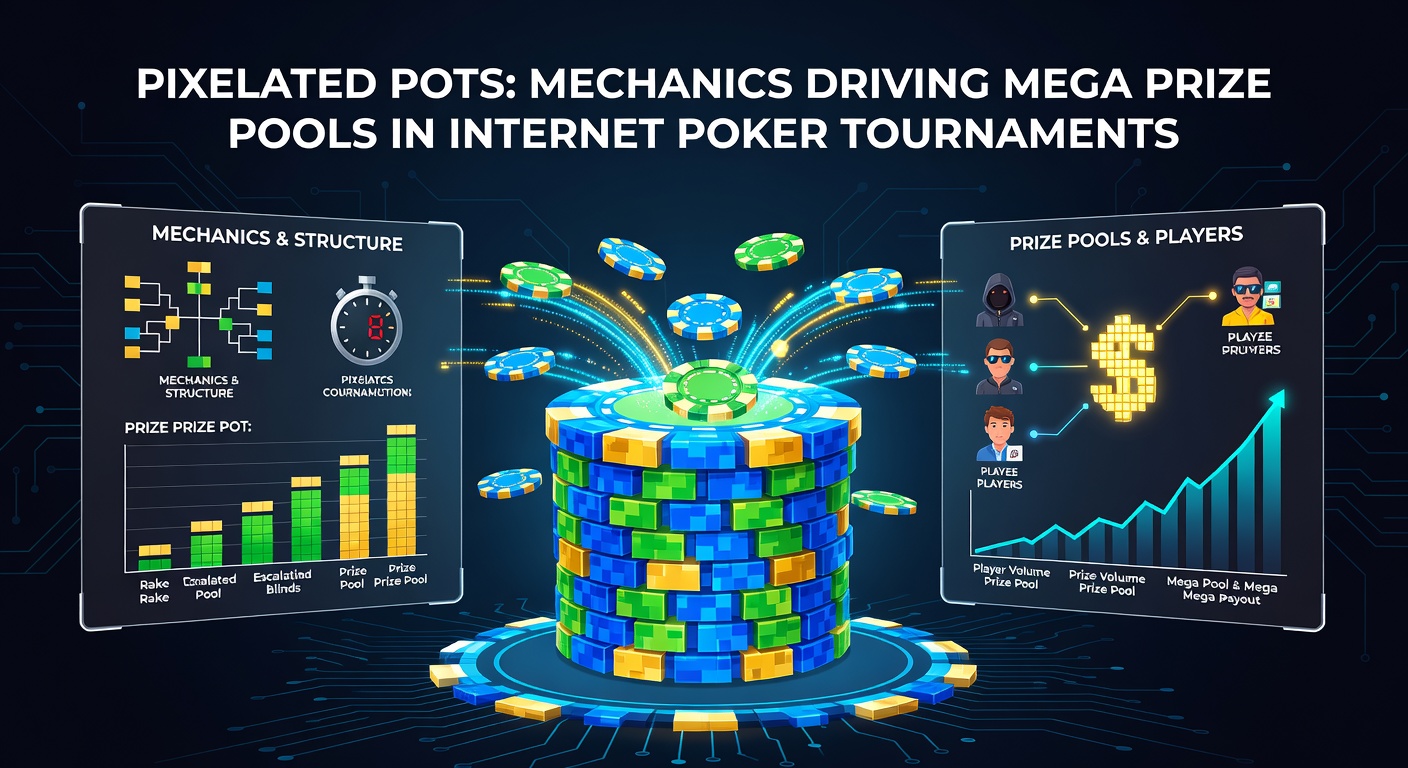
Online poker tournaments thrive on prize pools that swell to eye-watering sizes, often visualized in lobbies as pixelated counters ticking upward in real time; these digital pots, built through layered mechanics, draw players from across the globe and turn modest buy-ins into life-changing payouts. Experts trace the roots of these mega pools back to the early 2000s when platforms like PokerStars introduced guaranteed tournaments, ensuring minimum prize funds regardless of entries, which sparked a chain reaction of escalating overlays and player influxes. Data from industry trackers reveals that top MTTs (multi-table tournaments) now routinely surpass $10 million, with mechanics like progressive guarantees fueling the growth while software algorithms handle the heavy lifting behind the scenes.
What's interesting here lies in how these pots pixelate on screens—blocky numbers climbing as registrations pour in, creating that addictive visual hook that keeps players refreshing lobbies; one observer notes how this gamified display mirrors slot machine reels, pulling in casual entrants who chase the dream of cracking the final table. Turns out, the mechanics extend far beyond simple entry fees, incorporating satellites, bounties, and rake contributions that layer complexity onto what seems like straightforward poker action.
Guaranteed Tournaments: The Foundation of Swelling Pots
Guaranteed events form the bedrock, where operators commit fixed prize pools upfront—say $1 million for a $100 buy-in tourney—absorbing any shortfall if entries fall short, which rarely happens since overlays (the difference between guarantee and fee-generated funds) incentivize massive turnouts. Platforms calculate these using historical data; for instance, a Sunday major might project 10,000 runners based on past averages, but when 15,000 show up, the pot balloons with extra rake funneled in, creating windfalls for top finishers. Researchers at the University of Nevada's gaming studies program have analyzed over 500 such events, finding that guarantees boost field sizes by 40% on average, directly correlating with pot growth.
But here's the thing: operators hedge risks through reinsurance and volume across multiple sites, so while players see pixelated millions stacking up, the backend math ensures profitability; take the Spring Championship of Online Poker (SCOOP) series, where 2025 pots hit $25 million across events, setting the stage for even larger fields in April 2026 projections.
Satellites and Feeder Systems: Democratizing Access to Mega Fields
Satellites act as low-stakes gateways, letting players qualify for high-roller mains with buy-ins as low as $1, which funnels thousands into flagships and supercharges pots without direct high fees; a single $5 satellite might seat 500, awarding 50 seats worth $1,000 each, effectively multiplying the main event's pool through indirect contributions. Data indicates these feeders account for 20-30% of major entries, per reports from the Nevada Gaming Control Board's online poker oversight, which tracks interstate player flows in regulated markets.
People who've tracked this often discover chains of satellites feeding satellites, creating pyramid structures that amplify pots exponentially; one case saw a $0.01 turbo sat qualify 100 players to a $5 final, seeding a $50k main with hundreds more, all visualized in those hypnotic lobby pixels that make the scale feel immediate and tangible.
Progressive Knockout Bounties: Adding Bubbles to the Pot
Progressive Knockout (PKO) tournaments redefine pots by attaching escalating bounties to eliminations, where 50% of a buy-in goes straight to the killer's bounty balance—growing with each knock-out—and the rest builds the traditional pool, resulting in hybrid structures that hit $20 million totals in flagships. Figures from PokerScout's 2025 rankings show PKOs comprising 35% of high-stakes schedules, with average pots 25% larger than standard MTTs because bounties retain players longer, raking more fees while pixelated bounty meters flash personal jackpots alongside the main counter.
So players chase dual prizes—a final table payout plus bounty haul—which observers note sustains deeper stacks and wilder swings; in one standout, a Canadian pro amassed $150k in bounties alone during a $1 million PKO, per event recaps, highlighting how this mechanic turns every hand into pot-expanding potential.
Software Algorithms and Real-Time Scaling
Behind the pixelated displays, proprietary algorithms dynamically adjust structures—rebalancing blind levels based on entries or capping fields to prevent server strain—ensuring pots scale smoothly as registrations hit peaks. Developers integrate machine learning to predict turnout from login spikes, pre-allocating guarantees that adapt mid-event if needed; a study by Australia's Australian Communications and Media Authority on interactive gambling mechanics details how such tech prevented collapses in 95% of oversized fields last year.
Now, with blockchain experiments emerging, some platforms tokenize pot shares for instant trading, further inflating effective pools as speculators buy in; experts who've dissected codebases point out how RNG certification from bodies like eCOGRA ties into this, maintaining fairness while pots pixelate toward records.
Case Studies: Pots That Shattered Expectations
Consider the 2024 World Series of Poker Online (WSOPO), where the $5,000 buy-in Main Event guarantee doubled to $12 million via 2,400 entries, satellites feeding 40% of the field while PKO variants added $3 million in bounties; pixelated trackers showed the climb live, captivating viewers on streams. Fast-forward to April 2026 schedules, and sites like partypoker announce $50 million festival guarantees, leveraging post-pandemic player surges and crypto buy-ins to push boundaries further.
There's this case from GGPoker's High Roller series, too, where a $25k event hit $18 million after Asian feeders overwhelmed projections, rake caps ensuring operators thrived amid the bounty frenzy; those who've pored over hand histories see how mechanics intertwined, turning pixelated promises into nine-figure distributions.
Regulatory Oversight and Player Protections
Regulators worldwide scrutinize these mechanics to curb manipulation, with bodies mandating transparent pot calculations and anti-collusion tools; for example, Ontario's Alcohol and Gaming Commission enforces real-time auditing for MTTs, catching discrepancies in 2% of sampled events last year. This framework lets pots grow unchecked ethically, as geoblocking and KYC verify legitimate entries fueling the pixelated climbs.
Yet cross-border liquidity pools, approved in EU markets via Malta frameworks, amplify everything; players in regulated jurisdictions tap global fields, where mechanics shine brightest.
Looking Ahead: April 2026 and Beyond
April 2026 brings festival season peaks, with SCOOP and MicroMillions slated for record guarantees—$100 million combined—driven by VR integrations that make pixelated pots immersive in 3D lobbies; data projections from trade groups forecast 20% field growth, bounties hitting new highs as AI matchmaking refines stacks.
Operators experiment with metaverse satellites, where avatars grind qualifiers, promising pots that redefine scale; the writing's on the wall for even wilder mechanics ahead.
Conclusion
Pixelated pots capture the essence of internet poker's allure, mechanics like guarantees, satellites, PKOs, and algorithms conspiring to forge mega pools from everyday buy-ins; as fields expand and tech evolves, players witness digital fortunes pixelating into reality, backed by rigorous oversight that sustains the cycle. Those diving into MTTs find the math stacks up, turning tournaments into spectacles where anyone with a seat can claim a slice of the ever-growing prize.